
Human Cannonball: History, Mechanics, and Risks
hace 1 semana · Actualizado hace 1 semana
A human cannonball is a circus act in which a performer is launched from a device designed to resemble a cannon toward a prepared landing area. Rather than using a conventional gunpowder explosion, the device relies on mechanical systems such as springs or compressed air to propel the performer through the air.
Originating in the 19th century, the act became one of the most recognizable attractions in circus entertainment. Its history, launching mechanisms, world records, and safety risks reveal how this extraordinary performance evolved over time.
History of the Human Cannonball
The human cannonball act emerged from a series of 19th-century experiments in launching performers through the air. Early launching devices, acts advertised as human cannonball performances, and later circus spectacles developed in stages.
George Farini and Lulu: The Earliest Human Launches (1871–1873)
In 1871, showman William Leonard Hunt, better known as the Great Farini, patented a device designed to propel a person into the air. Called a “projector,” it used springs and rubber rather than a traditional cannon barrel. The performer was launched toward an aerial apparatus instead of being fired across an arena to a distant landing area.
Farini brought the act to New York’s Niblo’s Garden in 1873. The featured performer was Lulu, the stage name of Samuel Wasgate, Farini’s adopted son, who appeared in women's clothing. In a stunt known as the “Lulu Leap,” the apparatus sent Lulu upward to catch a suspended trapeze.
These performances established the human projectile as circus entertainment, but differed from later cannonball acts.
Zazel and the Rise of the Human Cannonball Act in 1877
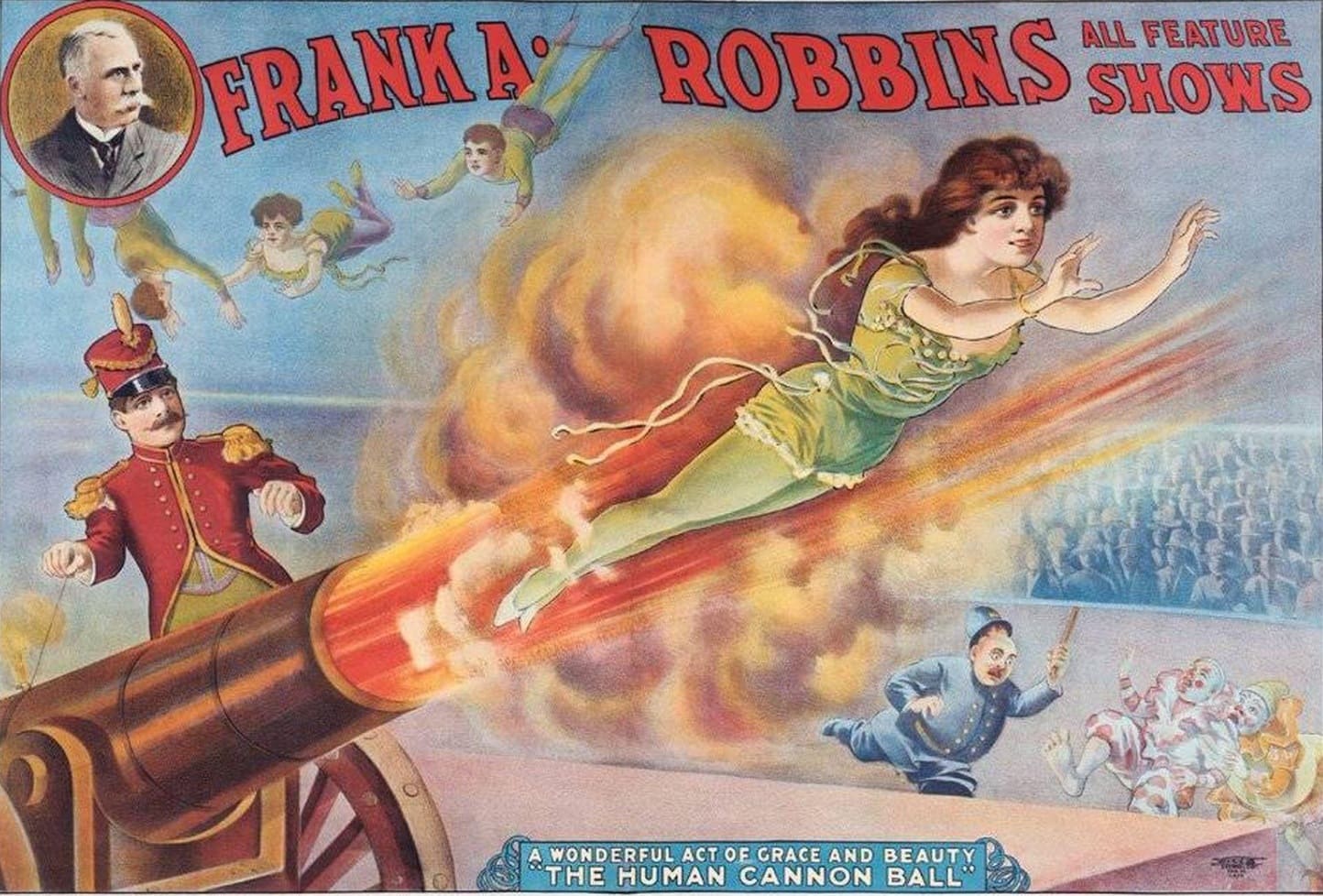
Rossa Matilda Richter, known professionally as Zazel, became one of the earliest stars associated with the human cannonball name. In 1877, she performed at the Royal Aquarium in London in an act advertised as a human cannonball. The presentation used the dramatic imagery of a cannon firing a person.
Zazel later appeared with P. T. Barnum’s circus, helping introduce the spectacle to broader audiences. She is frequently called the first human cannonball, but that description needs qualification. Farini and Lulu had performed human-launching stunts years earlier. The Circus Historical Society also documents an American circus advertising a man shot from a cannon in 1875, although that performer remains unidentified. Other historical accounts identify George Loyal and Ella Zuila in related aerial acts.
The distinction is between early human-launching acts and performances promoted under the human cannonball name. Zazel is a landmark in the latter tradition, not necessarily the first person ever propelled through the air for entertainment.
The Zacchini and Smith Families: Making the Act Famous
In the 20th century, the Zacchini family helped turn human cannonball performances into a major circus attraction. Ildebrando Zacchini led the family’s traveling circus, while his son Edmondo developed a compressed-air cannon in Cairo in 1922, according to the Bibliothèque nationale de France. Several family members later performed with Ringling Bros. in the United States. Brothers Vittorio and Hugo became known for a double-barreled version of the act, demonstrating how performers continued to adapt the spectacle.
Later, David “Cannonball” Smith Sr. and his son David “the Bullet” Smith Jr. kept the tradition visible to modern audiences through widely publicized launches and record attempts.
How Does a Human Cannonball Work?
A human cannonball may look like someone being fired from an artillery weapon, but the act relies on a mechanical launcher concealed inside a cannon-shaped tube. The device accelerates the performer and releases them into the air, where they follow a curved path toward a designated landing area.
How the Cannon Launches a Person: Springs and Compressed Air
Early human-launching devices used springs and elastic materials to store energy before a performance. Later versions commonly relied on compressed air. Although these technologies differ, both produce the force needed to propel a performer through the barrel.
In a typical design, stored energy drives a movable platform or carriage beneath the performer. As the platform accelerates, it transfers motion to the person riding it.
The mechanism therefore operates more like an enclosed catapult than a military cannon. Instead of using an explosive charge to fire a projectile, it relies on stored mechanical energy to launch a human performer.
What Happens During Launch and Flight?
The performer begins inside the barrel, positioned on the launching mechanism. When activated, the platform moves forward, accelerating the performer toward the opening. Near the end of its travel, the platform stops inside the cannon while the performer continues into the air.
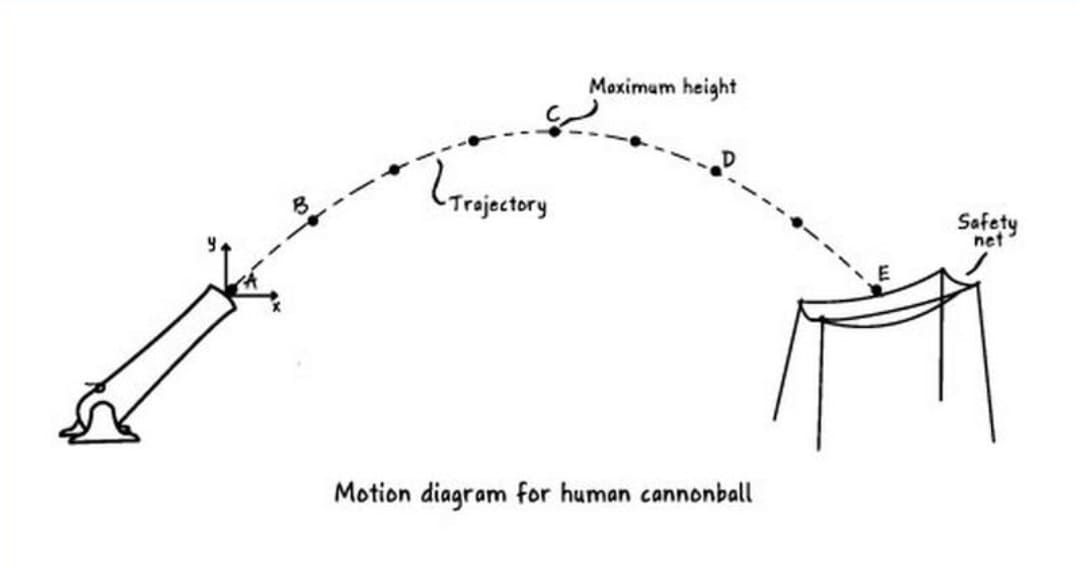
Once airborne, the performer moves forward through momentum while gravity pulls them downward, creating the curved trajectory spectators see.
This motion follows the basic principles of projectile physics. The flight path depends primarily on the speed and direction at release, while gravity and air resistance influence the movement through the air.
Unlike an aircraft, the performer has no engine or wings to sustain flight. The trajectory is largely determined before takeoff, with the designated landing area positioned along the expected path.
Does a Human Cannonball Use Gunpowder?
No. Human cannonball acts generally do not use gunpowder to propel the performer. Springs, compressed air, or similar mechanical systems supply the launching force.
The loud explosion, flash, or cloud of smoke often associated with the act is usually a theatrical effect designed to imitate a conventional cannon firing.
Some performances have used gunpowder or pyrotechnics to create these visual and sound effects. However, they are separate from the propulsion mechanism and do not provide the force that launches the performer.
This distinction explains why a human cannonball can resemble a traditional artillery demonstration while operating through an entirely different mechanism.
Human Cannonball World Records
Human cannonball world records distinguish between horizontal distance and peak height. Launch speed is another way to describe a performance, but reported speed estimates should not be confused with certified distance or height records.
How Far and How High Can a Human Cannonball Fly?
Guinness World Records lists David Smith Jr.’s 2018 flight in Tampa, Florida, at 195 feet (59.43 meters) for distance. For height, it lists his 2019 launch in Riyadh, Saudi Arabia, at 89 feet (27.12 meters).
These figures answer different questions: how far a performer travels horizontally and how high they rise. Accounts of Smith Jr.’s 2011 launch estimated a speed of approximately 75 mph (120 km/h); that figure is an estimate, not a certified speed record.
David Smith Sr. and David Smith Jr.: Record-Breaking Launches
An archived promoter’s account credits David “Cannonball” Smith Sr. with a 200-foot-4-inch (61.06-meter) flight at the Steele County Free Fair in Owatonna, Minnesota, on August 31, 2002. Guinness documented his son David “the Bullet” Smith Jr.’s 193-foot-8.8-inch (59.05-meter) flight in Italy in 2011.
| Performer | Year | Distance | Documentation |
|---|---|---|---|
| David Smith Sr. | 2002 | 200 ft 4 in (61.06 m) | Archived promoter claim |
| David Smith Jr. | 2011 | 193 ft 8.8 in (59.05 m) | Guinness report |
| David Smith Jr. | 2018 | 195 ft (59.43 m) | Guinness record listing |
Although the 2002 figure is greater, its measurement basis and recognition cannot be established from Guinness’s currently published listing. Guinness’s 2018 news report also gives a slightly different distance of 59.33 meters; the table follows its official record page.
Human Cannonball Risks and Safety Measures
Human cannonball performances carry serious risks even when the launching mechanism works correctly. The greatest dangers involve the flight trajectory, landing equipment, and the possibility of an uncontrolled impact.
Why Landing Is the Most Dangerous Part
Landing is generally the most dangerous part of a human cannonball act. Once airborne, performers have limited control over their trajectory, leaving little room to correct errors before reaching the target.
A miscalculation, unexpected wind conditions, or equipment failure can cause a performer to miss the safety net or strike its supporting structure. Even landing in the intended area can cause injuries if the impact is not properly absorbed.
Potential consequences include fractures, spinal injuries, head trauma, and, in severe cases, death.
Safety Nets, Airbags, and Pre-Launch Checks
Human cannonballs typically land on specially positioned safety nets or large inflatable cushions designed to absorb impact and slow the performer gradually.
Before a performance, crews check the landing equipment, its supports, and the expected flight path. Some acts have also used weighted test dummies to evaluate where the performer is likely to land.
Weather conditions, particularly wind, can affect outdoor performances and must be considered when assessing risks.
These precautions help explain how human cannonballs survive their launches, but they cannot guarantee safety. Protective equipment is effective only when properly positioned and functioning as intended.
Notable Human Cannonball Accidents
Several documented human cannonball accidents illustrate the consequences of failed landing systems.
On April 25, 2011, Matthew Cranch died during a stunt show in Kent, England, after his safety net collapsed. A subsequent inquest ruled his death accidental and identified problems with the net's release mechanism.
More recently, on March 2, 2025, Chachi “The Rocketman” Valencia was seriously injured at the Riverside County Fair and National Date Festival in Indio, California. He struck the edge of his safety net and fell onto the ground. Accounts published during his recovery attributed the altered trajectory to a sudden gust of wind.
Both incidents demonstrate that even experienced performers remain vulnerable to landing-related failures and unpredictable conditions.
Human Cannonball Technology Beyond the Circus
Although best known as a circus stunt, the human cannonball principle has also inspired proposals for military and emergency-response operations. During World War I, members of the Zacchini family reportedly considered launching Italian soldiers over enemy lines, but the concept was never deployed.
In 2006, U.S. patent application US20060086349A1, Controllable Launcher, described a guided device designed to propel a person onto an elevated structure. Its inventors included Dean Kamen, and the application acknowledged support for aspects of the work through DARPA and the U.S. Army. Potential users included military or emergency-response personnel reaching difficult-to-access locations.
These military and emergency-response concepts remained proposals rather than demonstrated operational systems. A patent application does not establish that a launcher was adopted for real missions.
Related articles: